
Comanche County Three-Day Releases
Comanche County does not publish a distinct one-click rolling 72-hour feed. The county-linked BlueHorse system instead enables a Past Inmate search with beginning and ending dates. A reader can enter a three-calendar-day span and review bookings that show release dates in that range. The result should be described as a custom date search, not as an official 72-hour list.
This wider view is useful after a weekend or when a same-day result has rolled out of Past 24. It can gather several calendar days in one pass, but calendar boundaries are not the same as an exact moving 72-hour clock. A search run near midnight can include more or less elapsed time than the phrase “last 72 hours” implies. Always state the dates, the Central Time access time, and the fact that the range was user-selected.
Check Comanche County 72-Hour Releases
Enter through the official Comanche County Detention Center page and follow Current Inmates to the BlueHorse application. The label on the county page describes the main link, not all tools within the application. Choose Past Inmate rather than the live roster. Use precise dates and, when possible, a name or identifier. A narrow query makes it easier to distinguish duplicate names and repeat bookings.
- Choose the beginning and ending dates that cover the three calendar days being reviewed.
- Write down the exact range and the time the search was accessed in Central Time.
- Use last and first name, State ID, or permanent ID when known to reduce unrelated results.
- Deduplicate entries by booking number. Do not merge two bookings because they share a jacket number.
- Open each relevant detail and inspect release date, location, farm-out, charges, bonds, detainers, and court information.
- Match the case in OSCN or Municipal Court and verify any transfer in ODOC, VINE, or the receiving agency.
- Ask CCDC for the release log or named release sheet if the date search appears incomplete.
The BlueHorse Past Inmate interface is the county-linked source for setting the custom dates.
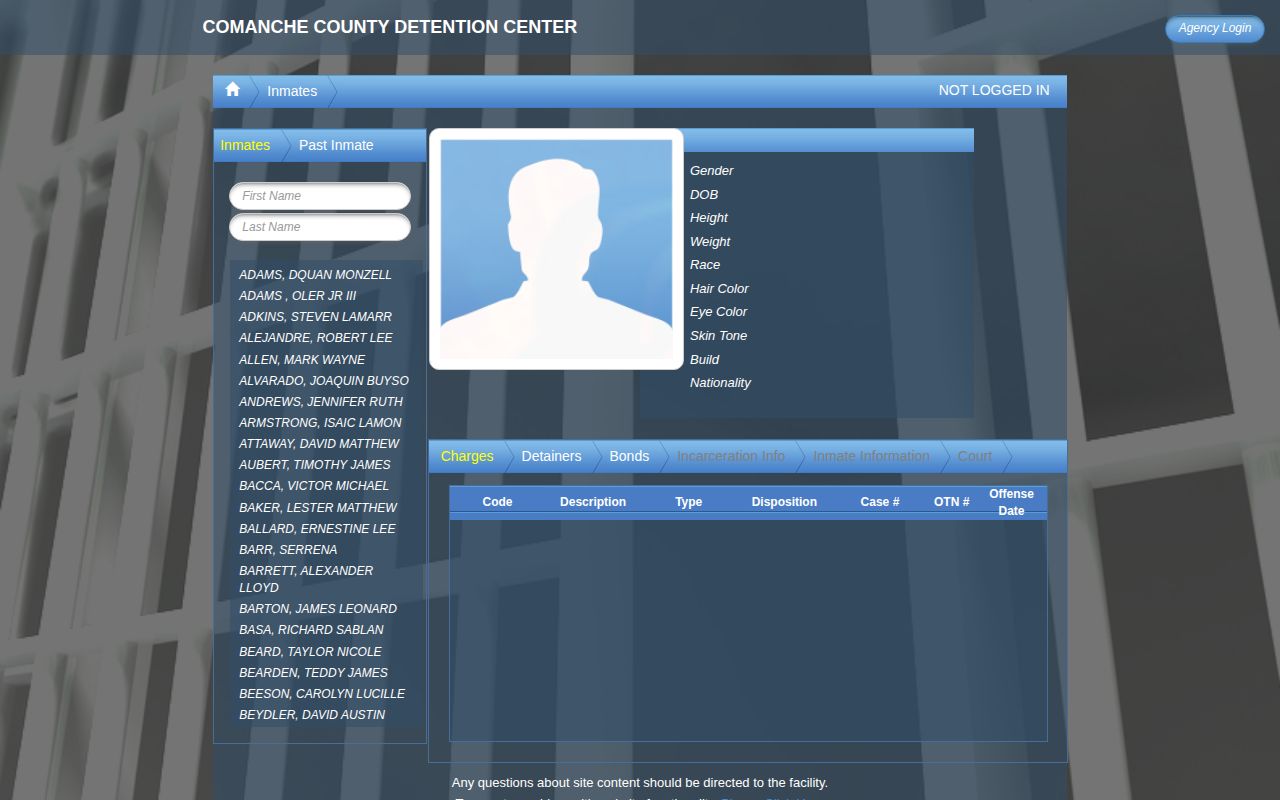
The image shows the source used for the custom range, while the text label keeps it distinct from an official fixed 72-hour endpoint.
For a same-day rolling check, use the Comanche County 24-Hour Release List and its genuine Past 24 control. The two searches answer related but different time questions.
Comanche County Three-Day Record Fields
The custom range returns the same kind of past-booking information used by the shorter view. Observed public result data included a booking number, jacket or permanent number, name fields, birth date, location, release date, and farm-out indicator. A detail screen can add incarceration, charges, bonds, detainers, court data, and an image function. These fields help explain whether CCDC recorded a release or movement, but the system publishes no guaranteed retention period or refresh cadence.
| Field | What it contributes |
|---|---|
| Booking number | Separates one jail stay from another within the three-day range. |
| Jacket or permanent number | Links local identity across bookings but is not a substitute for the booking number. |
| Name and birth date | Provide identity clues that still require careful matching. |
| Release date | Shows the reported end date for that booking; it may not include a time. |
| Location and farm-out | Can signal movement or continued custody rather than community release. |
| Bond and detainer detail | May show a release path or another agency's hold. |
| Charge and case data | Connect the booking to the court source that explains legal authority. |
The date labels must stay distinct. Booking date marks intake. Offense date describes the alleged conduct. Court filing date is when an event posted. Release date marks the facility exit. A court case-closed label does not supply an exact CCDC gate time, and a jail release date does not prove that every charge was dismissed.
Comanche County 72-Hour Search Quirk
Comanche County's public setup has an unusual split. The county calls its vendor link “Current Inmates,” yet the application enables Past Inmate and a true Past 24 function. There is no matching fixed Past 72 button. The date boxes can construct three calendar days, but a custom range does not become an official rolling feed just because it spans roughly the same period.
This distinction protects the result from false precision. A query for Monday through Thursday may include date-only boundaries whose treatment differs near midnight. State the range in plain terms, such as “Past Inmate search for July 28 through July 31, accessed July 31 in Central Time.” If the online rows and the known timeline conflict, request the same timestamps from CCDC and ask whether an existing jail-management report or export covers them.
Does no result mean no release? No. A name variation, late update, older booking, municipal custody, state transfer, or another agency can explain the absence. Negative search results have several meanings.
Weekend Comanche County Release Timing
A three-day range is especially helpful after weekend court closures. Comanche County publishes a weekend schedule that permits certain misdemeanor bond payments at CCDC using cash, cashier's check, or money order. The schedule does not apply to felonies. It also excludes several categories, including weapons, violence or threats, injury, protective-order violations, domestic abuse or stalking, most warrants, and a person already on other bonds.
DUI, impaired-driving, and public-intoxication bookings have an eight-hour wait, subject to listed aggravating exclusions. Those rules can affect when a qualifying release appears across a weekend. They do not promise a release time. The record must still show that bond was accepted, other holds cleared, and jail processing ended.
Holidays can produce a similar need for a broader review, but no fixed CCDC holiday schedule or automatic early-release rule was verified. Court orders may precede physical exit, and a vendor update may follow it. Use the custom range to collect possible entries, then verify the named booking rather than assuming the list is complete.
Note: CCDC publishes no fixed release-processing hours, exit location, or ordinary turnaround, so call 580-250-1902 for current operational details.
Comanche Release or Transfer
A release from CCDC describes departure from that jail. It can be a return to the community, but it can also be a farm-out or transfer to ODOC, another county, federal or military authority, treatment, or immigration custody. The three-day range should not combine all departures under the phrase “got out.”
| Record clue | Likely meaning | Confirmation source |
|---|---|---|
| Bond status and release date | Possible community exit with the case pending | CCDC record and court bond order |
| Time served or court release | Local authority to end custody | Judgment, order, and CCDC exit record |
| Farm-out or receiving location | Movement to another custodian | Named receiving facility or agency |
| State sentence or ODOC entry | County stay ended while state custody continued | ODOC Offender Lookup and VINE |
| ICE or federal hold | Possible transfer out of county custody | ICE, BOP, federal docket, or counsel as applicable |
A person can also move to Lawton Community Corrections Center and remain legally in ODOC custody. Parole is physical release with supervision, while final discharge ends the identified state obligation. The county list alone cannot supply those distinctions.
Request Comanche Three-Day Release Records
If the custom range omits a known event or lacks the exact time, use the county Open Records Request Form. Select Comanche County Detention Center or Inmate Records and provide the exact beginning and ending timestamps. For one person, include the full name, aliases, birth date if needed, and booking number. For a period, ask for an existing release log, jail-management report, or export rather than asking staff to conduct research.
Request booking date and time, release date and time, release disposition, releasing authority, public destination or transfer agency, bond information, and case numbers. Ask that transfers be identified separately. The form goes through the County Clerk at 315 SW 5th Street, Suite 304, Lawton, OK 73501, phone 580-355-5214. It says records normally go by email and tells requesters not to send payment until an exact fee notice arrives.
Court documents are excluded from the general county form. Call the Comanche County Court Clerk at 580-355-4017 for those records. Oklahoma VINE can confirm a participating agency's custody event, and ODOC applies when the person entered state custody. For a focused named-person workflow across systems, use the Comanche County released inmate search.
Confirm Comanche 72-Hour Releases
A durable three-day result has four parts: the exact custom range, the booking number, the affirmative release date, and a second source that explains the event. The court order can show legal authority. VINE can show an agency-fed custody change. ODOC can show state custody or supervision. CCDC can provide the formal release sheet or liberation instrument.
Absence from the current roster is only a clue. Absence from the custom range is also only a clue. Reserve “confirmed released” for an affirmative release event, and describe a farm-out or transfer as continued custody unless the receiving record shows otherwise. This wording keeps the three-day list accurate even when separate databases update on different schedules.